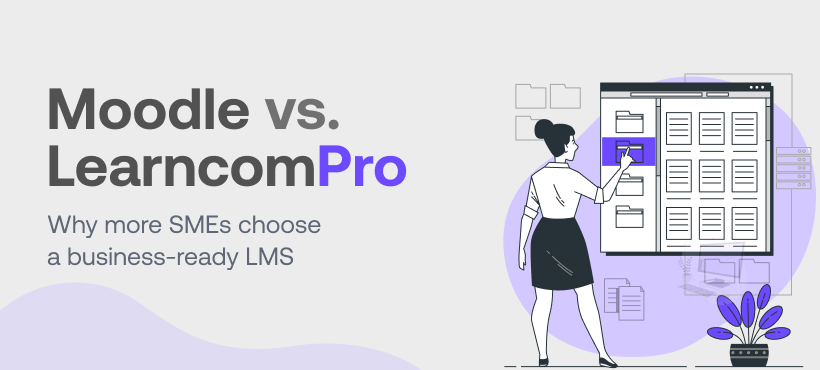
Moodle vs. LearncomPro: Why More SMEs Are Choosing Business-Ready Learning Platforms
Michał Kruszyński
•
5 min read
When organizations start searching for a Learning Management System (LMS), Moodle is often one of the first solutions they encounter. It is well-known, widely adopted, and open-source. For years, it has been a popular choice among universities, schools, and educational institutions around the world. But for small and medium-sized enterprises (SMEs), the key question is not: “Which LMS is the most popular?” The real question is: “Which platform will help us train employees faster, easier, and with lower long-term costs?” This is where many organizations discover that Moodle and LearncomPro were built for completely different purposes.
Moodle Was Built for Education, LearncomPro Was Built for Business
Moodle originated in the academic world.
Its architecture, workflows, and administration model were designed to support educational institutions, teachers, courses, and academic programs.
LearncomPro was built from the ground up for corporate learning.
The platform focuses on business challenges such as:
Employee onboarding
Compliance training
Cybersecurity awareness
AML training
Mandatory training programs
Employee development
Audit readiness
This difference in philosophy affects everything that follows.
Organizations do not buy learning platforms because they need technology.
They buy learning platforms because they need results.
The Hidden Cost of “Free”
One of Moodle's most attractive features is that the software itself is free.
At first glance, this seems like a major advantage.
However, many organizations discover that free software rarely means free ownership.
Before Moodle can be used effectively, companies typically need:
Hosting infrastructure
Installation
Configuration
Security setup
User management
Backup procedures
Ongoing maintenance
Updates
Technical administration
In many cases, organizations also need external consultants or internal LMS specialists.
As a result, the total cost of ownership often becomes significantly higher than initially expected.
LearncomPro follows a different model.
Organizations receive:
A ready-to-use platform
Technical maintenance included
Security management included
Dedicated support
Predictable subscription costs
Instead of budgeting for multiple suppliers and technical resources, companies know exactly what they will pay and what they will receive.
Your Employees Need Training, Not an LMS Project
One of the biggest differences between Moodle and LearncomPro is deployment speed.
A typical Moodle implementation requires:
Hosting selection
Installation
Configuration
Customization
Plugin evaluation
Testing
User setup
Only after these steps can learning begin.
For SMEs operating in rapidly changing environments, this delay can become a serious business issue.
New employees need onboarding today.
Cybersecurity threats exist today.
Compliance requirements exist today.
LearncomPro is designed to be operational within days.
Organizations can focus on training employees rather than building and maintaining infrastructure.
Who Will Manage the Platform?
Many companies underestimate the administrative burden associated with LMS platforms.
With Moodle, organizations often require someone who understands:
User administration
Plugin management
Security updates
Backup procedures
System configuration
In practice, HR departments frequently become dependent on IT teams or external contractors.
LearncomPro was designed differently.
Administration is focused on HR managers, L&D specialists, and business users.
The platform allows organizations to manage learning processes without requiring technical expertise.
This significantly reduces operational complexity and speeds up day-to-day learning management.
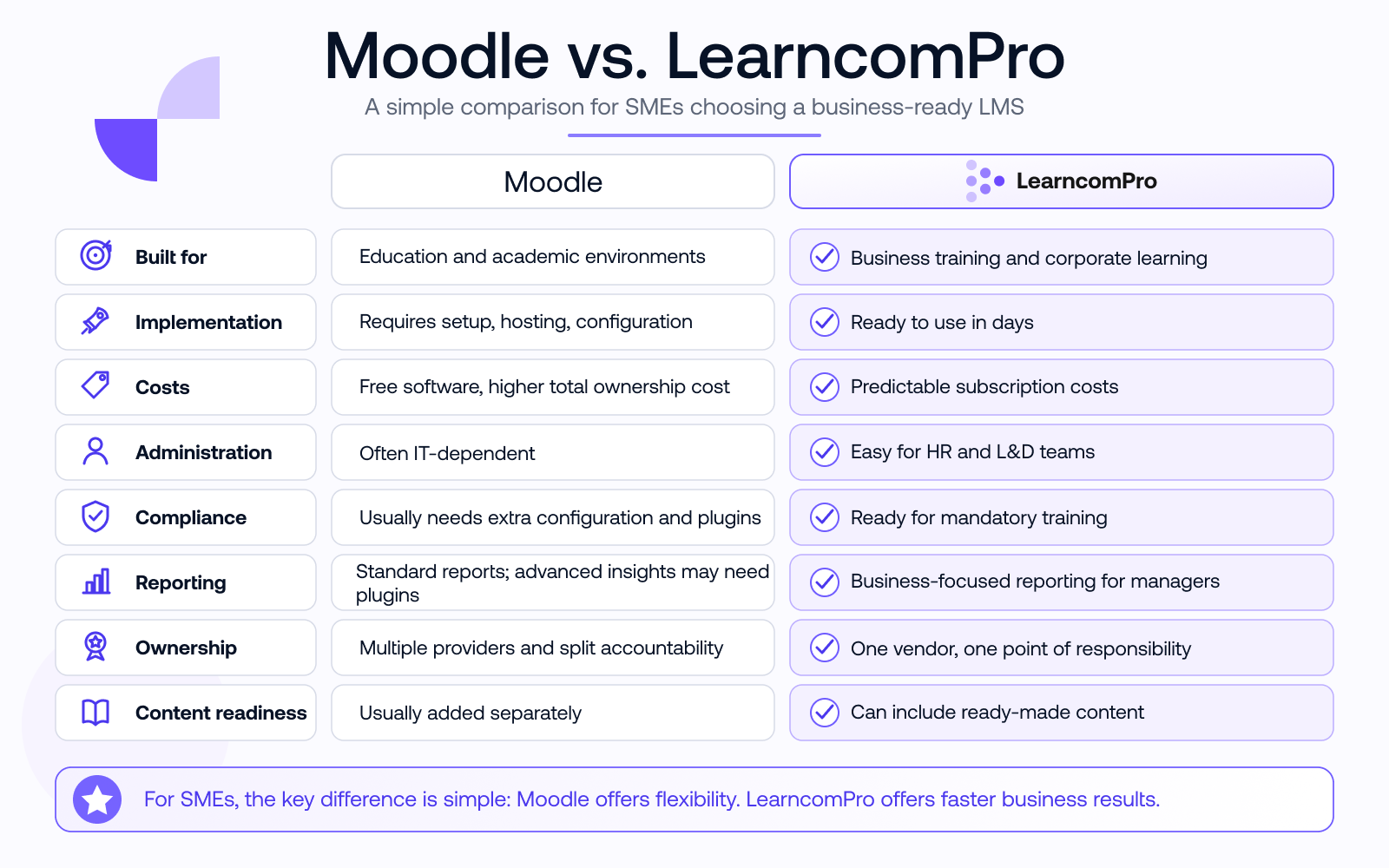
Moodle vs. LearncomPro comparison
Compliance Training Should Not Require Custom Development
Across Europe, Central Asia, and many other regions, organizations face increasing compliance obligations.
Training is required in areas such as:
Cybersecurity
Information security
AML
Internal regulations
Mandatory workplace training
While Moodle can support these initiatives, organizations often need additional configuration and plugins before they can manage compliance effectively.
LearncomPro is already prepared for these scenarios.
The platform includes tools specifically designed for:
Mandatory training assignment
Role-based training distribution
Progress monitoring
Certification management
Compliance reporting
Organizations can start managing compliance programs immediately rather than building the required infrastructure first.
Reporting That Business Leaders Actually Need
One of the most common frustrations among HR and training managers is reporting.
Business leaders need answers to simple questions:
Who completed the training?
Which departments are overdue?
Which employees require follow-up?
Can we demonstrate compliance during an audit?
LearncomPro delivers business-focused reporting designed specifically for managers and HR departments.
Moodle provides standard reporting capabilities, but advanced reporting frequently requires additional plugins, configuration, or technical expertise.
For organizations that need quick access to decision-making data, this distinction matters.
One Vendor = One Responsibility
Perhaps the most overlooked difference is accountability.
In a typical Moodle environment, responsibility is often divided between:
Hosting providers
Integrators
Internal IT teams
External consultants
Administrators
When problems occur, identifying ownership can become complicated.
With LearncomPro, one vendor is responsible for:
Platform availability
Technical maintenance
Security
Support
Updates
Organizations gain a single point of accountability and significantly reduce operational risk.
Security Matters More Than Ever
Cybersecurity concerns continue to grow across all industries.
Organizations increasingly evaluate not only platform functionality but also security management.
With Moodle, customers are typically responsible for applying updates, managing patches, and maintaining platform security.
LearncomPro handles updates and maintenance centrally.
This approach reduces the risk of outdated systems and helps organizations maintain a secure learning environment without dedicating internal resources to platform administration.
Learning Content Included
Another significant difference is content readiness.
Many organizations selecting Moodle still need to:
Create content internally
Purchase content separately
Import courses from external providers
This often extends project timelines and increases costs.
LearncomPro can be delivered together with ready-made training programs covering:
Cybersecurity awareness
Compliance
AML
Onboarding
Mandatory corporate training
Organizations can launch complete learning initiatives almost immediately.
Why SMEs Are Choosing LearncomPro
For educational institutions, Moodle remains a respected and powerful platform.
For SMEs, however, priorities are different.
Growing organizations need:
Fast deployment
Predictable costs
Minimal technical involvement
Built-in compliance support
Business-focused reporting
Dedicated support
Ready-made content
Clear accountability
This is exactly what LearncomPro was designed to deliver.
Conclusion
Choosing an LMS should not be about selecting the platform with the most customization options. It should be about selecting the platform that creates the fastest and most measurable business value.
Moodle gives organizations flexibility.
LearncomPro gives organizations results.
For SMEs looking to onboard employees faster, manage compliance efficiently, improve cybersecurity awareness, and reduce administrative burden, the choice is becoming increasingly clear.
The future of corporate learning is not about building learning infrastructure. It is about delivering learning outcomes. And that is precisely where LearncomPro was built to excel.
We’ll be happy to let you know what we can build together and prepare an offer tailored for your organization. We're committed to responding to every inquiry as fast as we can.
Oops! Something went wrong while submitting the form.
We use cookies
By clicking “Accept”, you agree to the use of cookies to improve the functioning of the website and to run statistics and Google Ads campaigns. You can manage your preferences or continue without consenting to additional cookies.

.png)