The End of Excel: Turning Chaos into a Learning Strategy
LearncomPro
•
7 min read
In many organizations, there comes a moment when someone opens a folder called “Training” and realizes that it can no longer work this way. See how to replace spreadsheet chaos with a real development strategy.
In many organizations, there comes a moment when someone opens a folder called “Training” and realizes—this can’t go on any longer.
Attendance lists, scattered presentations, PDFs, recordings, certificates, reporting data, unfinished charts for management, spreadsheets with reminders, schedules, mailing lists, message templates, backup copies of backups…
Yes, all of this can be organized, grouped, and labeled with proper dates. But at best, this creates only the illusion of order. Beneath the surface lies a system where more energy is spent managing tools than actually developing people.
From Improvisation to Strategy
Recent reports clearly show that companies can no longer afford a chaotic, improvised approach to Learning & Development.
The growing importance of adaptation, upskilling, and continuous learning is highlighted in reports such as:
The latter emphasizes that development opportunities are now one of the key reasons employees stay with a company. When people don’t see a clear path for growth-or tools that support it-they start looking elsewhere.
Organizations therefore need structured development paths and environments that genuinely support learning. HR is entering a phase where technology must actively support the process-not exist as a disconnected tool.
It’s no coincidence that, according to Select Software Reviews, the HR-tech market is growing rapidly. Companies are investing in tools that integrate processes and automate repetitive tasks. Manual solutions simply cannot keep up.
In this reality, Excel and other office tools-despite their strengths-are no longer enough.
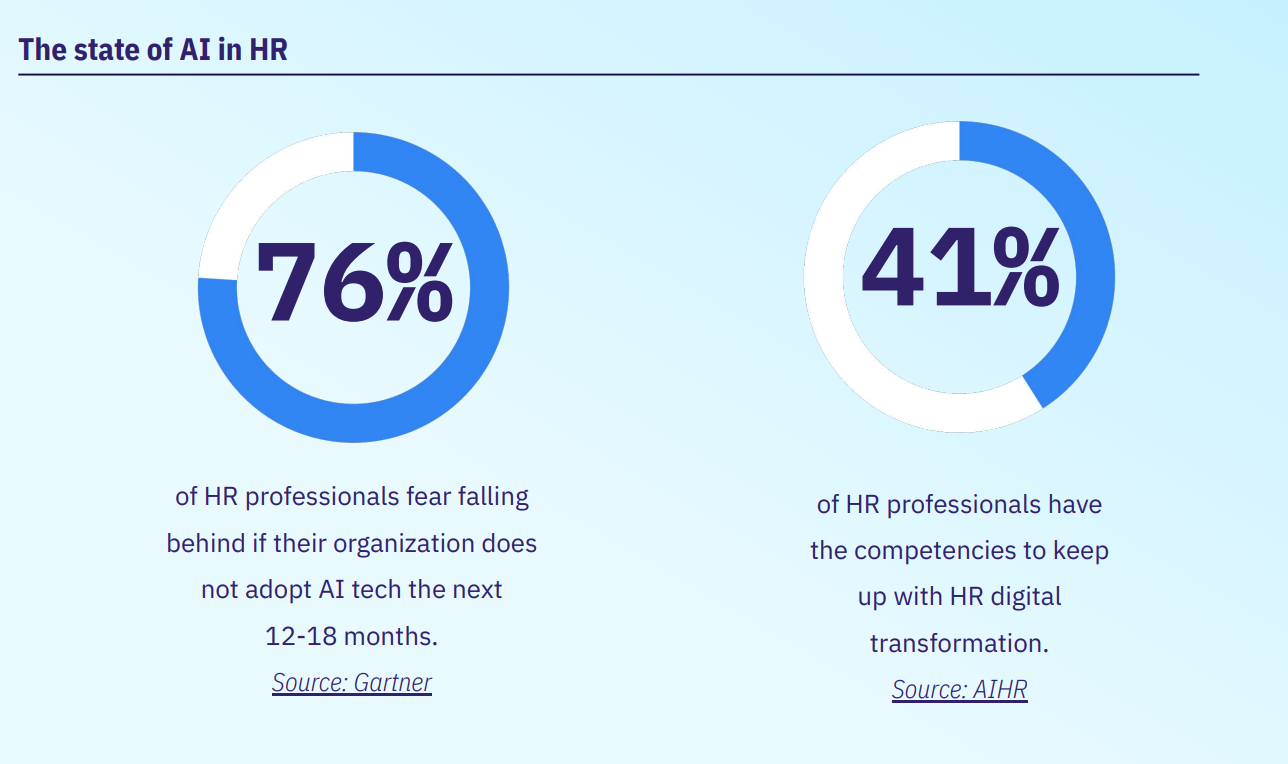
76% of HR professionals fear falling behind without implementing AI; 41% believe their skills are not keeping up with digital transformation. Source of the image: AIHR
Why Excel is no longer enough for training management
Spreadsheets remain essential in many areas of business. But managing employee development requires far more than tables and formulas.
As organizations grow, so does the complexity:
more data
more regulations
more reporting requirements
more operational dependencies
What initially worked well gradually turns into an inefficient system-error-prone and increasingly resource-intensive.
Three critical elements are typically missing:
Transparency - employees lack a single place to track their development journey
Consistency - fragmented files fail to create a coherent process
Reliable data - decision-making requires clear, trustworthy metrics
That’s why reports like Brightmine HR Technology Trends 2025 highlight a clear shift toward integrated platforms that automate processes and unify data.
A training platform as an alternative to Excel
If current tools are no longer sufficient, what should replace them?
The answer is simple: a dedicated online training platform.
Some may think an LMS (Learning Management System) is just an advanced version of Excel moved online. In reality, it’s something entirely different-a system specifically designed to manage learning and development in a structured, scalable way.
At its core, everything related to employee development is centralized in one place:
SCORM courses
documents
assessments
webinars
classroom training
certificates
performance data
learning history
Everything.
Onboarding without chaos – an example of platform use
What does this look like in practice?
Take onboarding as an example.
In a file-based system, onboarding involves dozens of micro-tasks and often multiple people:
sending links
tracking progress
updating spreadsheets
checking results
sending reminders
collecting and summarizing data
With a training platform:
new employees are automatically assigned to onboarding paths
progress is tracked in ready-to-use reports
certificates are generated automatically
deadlines are monitored
notifications are sent automatically
This frees up L&D and HR teams to focus on strategy and content development—while employees can quickly and effectively learn what they need and transition smoothly into their roles.
The role of artificial intelligence in modern training platforms
It’s already clear that training platforms outperform traditional office tools. But in 2026, even that may not be enough.
Today’s expectations go further-technology must actively enhance the learning experience.
Artificial intelligence is one of the most discussed trends, but real value comes from practical implementation-not slogans.
The real transformation happens when AI supports everyday interactions with knowledge.
A good example is LearncomPro, a platform developed by LLidero for over 12 years, featuring advanced capabilities such as:
Virtual Specialist - answers questions based on company materials
AI Support - helps users navigate the platform
Personalized recommendations - suggests next learning steps
Admin Assistant - supports HR in managing processes
Dedicated AI agents - tailored to specific organizational needs
These tools not only improve user experience but also enhance learning effectiveness and significantly reduce HR workload.
What changes when a training platform is implemented in an organization
LearncomPro is more than just AI.
The platform supports:
SCORM training
tests and surveys
advanced reporting and certification
creation of interactive courses from presentations
file sharing
user self-registration
webinars and classroom training
It is designed to scale-currently supporting nearly 300,000 active users-across multiple locations, languages, and full development paths.
All within a secure, intuitive environment that makes learning efficient and accessible-without chaos, without lost files, and without endless folders.
The Real Impact on the Organization
The shift from improvised, tool-based processes to a professional training system quickly delivers tangible results:
Employees gain a single, structured learning environment with clear expectations and AI-supported guidance
HR teams free up time for strategic work instead of administrative tasks
Management gains access to reliable, actionable data
We’ll be happy to let you know what we can build together and prepare an offer tailored for your organization. We're committed to responding to every inquiry as fast as we can.
Oops! Something went wrong while submitting the form.
We use cookies
By clicking “Accept”, you agree to the use of cookies to improve the functioning of the website and to run statistics and Google Ads campaigns. You can manage your preferences or continue without consenting to additional cookies.


.png)